GLENN HEIGHTS, Texas — The Glenn Heights City Council pushed back Tuesday on a planned expansion of the Red Oak Creek Regional Wastewater System, questioning the math behind the project and whether the numbers have been independently verified.
Based on Trinity River Authority’s presentation to the council, Glenn Heights’ projected wastewater cost of service would increase approximately 46% in 2027.
Matt Jalbert, Trinity River Authority’s northern region executive manager, briefed the council on the system’s capacity and the debt service member cities will be asked to fund. Glenn Heights has a long-term contract with the authority for water and wastewater service.
The treatment plant currently has 28 miles of pipeline, 11 meter stations, and two lift stations. Customers are billed on a flow rather than a flat rate, Jalbert said.
“The way this system is set up is that the customers are basically billed on what’s sent through our flow meters,” Jalbert said. “Then at the end of the year, everything is settled up, and you only pay the proportionate share for that revenue requirement each year, and then whatever’s left over, we actually give that money back to the cities.”
He said the arrangement is not a “take or pay” contract but is based on flow volume from each member city. Glenn Heights has a minimum flow requirement of about 35,000 gallons per day and typically accounts for about 33% of the system’s total flow, well above that minimum, Jalbert said.
By March 2024, the plant had already passed 90% of capacity and needed to be under construction, Jalbert told the council. He said the standard trigger for planning a project is 75% capacity, but usage climbed quickly as new homes and industrial development moved into the region.
The system serves six member cities — Cedar Hill, DeSoto, Glenn Heights, Lancaster, Ovilla and Red Oak. Jalbert said the authority collects 10-year growth projections from each city, including planned developments, permitting activity, and incoming industries with heavy water demand, and uses that data to plan expansions. The goal, he said, is to stay ahead of capacity needs rather than impose a moratorium on development.
The plant was just under 90% of capacity in 2025. If it reaches full capacity, the system would fall out of compliance with the Texas Commission on Environmental Quality, triggering a required expansion.
“If I don’t start the 12 MGD expansion based on our planned projections outward, we’ll be behind in those years in order to keep up with that growth rate,” Jalbert said, using the industry abbreviation for million gallons per day.
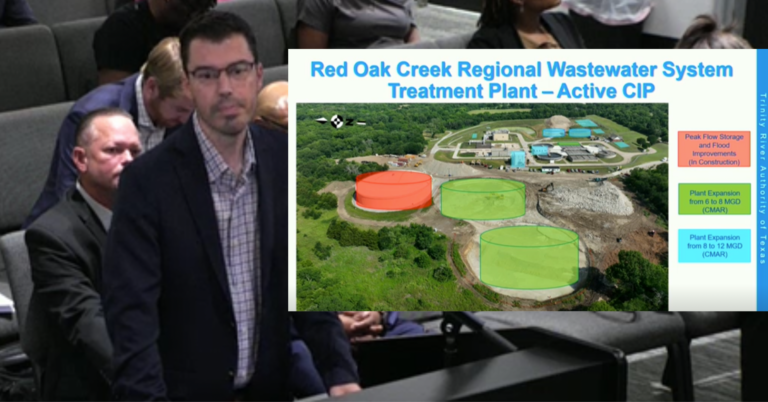
Crews are finishing a peak-flow storage station and building tanks for a 6-to-8 MGD expansion, with an 8-to-12 MGD package moving into planning. Archer Western was awarded the construction contract in August 2025. In December, the authority awarded a contract for two additional 7-million-gallon storage tanks. In April, a second contract covered yard piping, odor control, electrical and controls work, an expanded aeration basin, and a new 7.5-million-gallon pump at Lift Station 2. Jacobs was awarded the final design contract for the 8-to-12 MGD project.
Officials aim to bring the first phase online in 2027 while starting a second phase expected to be complete near the end of the decade. The plant has not been expanded since the early 1990s.
Councilwoman Washington asked what Glenn Heights’ proportional financial share of the expansion would be and whether the cost is locked in.
“That’s going to vary from year to year,” Jalbert said. “If you’ve got a lot more development coming that year, or if there is potentially some I&I [infiltration and inflow] coming in because we have a lot of heavy rain … it could range between 33 and 36% of the proportionate flow share that is going toward that revenue requirement each year.”
Jalbert said the authority builds conservative assumptions into its 20-year debt service projections, including a half-point increase in basis points each year and contingency funding.
“We raise our basis points by a half percent each year,” Jalbert said. “We also have contingency numbers built into those numbers so that way we try to give you the most conservative number … The market may be good, we may get 3% interest rates, compared to 4%. That will affect how much we pay on interest.”
He said treatment plant construction bids are coming in 25% to 30% over engineers’ estimates, citing the inherent risk in treatment plant projects and rising electrical costs, which he attributed to competition for tradespeople from data center construction in the region.
Councilman Travis Bruton said he understands the need for wastewater infrastructure investment, but that his responsibility is ensuring costs passed on to Glenn Heights residents don’t outweigh the benefit.
“If you look and think about our residents, one thing that we’ll all hear very, very much is about our water/sewer bill,” Bruton said. “Of course, our sewer rate is the highest part in our water/sewer bill. This, what you’re speaking of, directly impacts that.”
Bruton pressed Jalbert on whether the 33% figure represents Glenn Heights’ share of the system’s treatment capacity or its share of contributed flow — two different measures — and whether the number had been independently audited.
“It’s 33% of what’s sent through the system,” Jalbert responded.
Jalbert said an outside auditor reviews the authority’s budget and flow data annually, and that the authority cannot retain excess funds, meaning any surplus is returned to member cities. He said flow meters are calibrated quarterly and fall within industry standards.
Still, Jalbert says when he had a meeting with member cities in June, the consensus was that the area is growing, and the expansion has to begin. He said that if a project is delayed, it’s about an 8% increase in the cost the next year. Their budget year begins in December.
Councilman Hobbs asked what the outstanding bond amounts were before this project, to which Jalbert didn’t have the information available, but he will provide the information to the City of Glenn Heights once he is in possession.
Councilman Hobbs continued by asking about flow projections. By 2027, Jalbert anticipates we’ll be around 8M gallons, and says that about six months ago, we were around 5M gallons – which he clarified is at best guess “at this point.”
“[20]27 you’re at 8[M], [20]30 you’re at 12[M], that’s an increase of 4[M]. At [20]36 you’re at 15[M], which is 3[M] over six years, and you’re saying you won’t increase another 3[M] until 2058. You guys don’t think those numbers are a little skewed?” asked Hobbs.
“That’s where I’m saying we’re trying to be as conservative as we can,” Jalbert replied. “Now, like I said, this information is taken from the cities, so we look at these every year. As far as anything that’s out there, this graph is always constantly changing.”
Hobbs replied, “Being conservative, but being overly conservative is going to, I’ll just say it, screw the city over; because you’re talking about a 10 million gallon increase, and it takes 21 years to reach it, but you’re telling me in three years you’re going to increase four?”
“I can’t even call it being conservative,” said Hobbs. “That’s just kind of outrageous. I would estimate that 2058 number to be closer to probably 2040.”
Jalbert said he understood Hobbs’ point, but contended he met with the cities in June and they were adamant about seeing the growth, and he wants to hold them to this.
Councilwoman Allen asked if the $13.227 rate is paid by all cities, to which Jalbert said that would be the rate based on a gallon, but that’s not how they bill, as it’s based on the revenue requirement, which is based on the flow-proportionate share.
“I do not speak for the entire council; that’s my disclaimer, but we are not happy,” said Allen. “I am going to send a follow-up email as I think there’s a lot more information that we need, and if you could get back to us as soon as possible, that would be appreciated.”
Residents are encouraged to reach out to their councilmembers to learn more and seek clarification as this matter continues to be discussed.
This is a developing story.
To watch the meeting: https://www.glennheightstx.gov/229/City-Council-Meeting-Videos
To read more about Glenn Heights Approved Developments: https://glennheightsfuture.com/glenn-heights-could-top-30000-residents-is-commercial-growth-keeping-up/
- Glenn Heights Council Meeting Ends in Under Two Minutes
- Texas Ethics Commission Fines Mayor Brown and 2025 “Forward Four” Candidates
- Glenn Heights City Manager Clifford Blackwell Offered Two-Year Contract Extension
- Past Zoning Decisions Limit Glenn Heights Commercial Growth
- Glenn Heights Budget 2026 Approved After Complicated Votes