Glenn Heights Could Top 30,000 Residents. Is Commercial Growth Keeping Up?
Nearly 3,000 housing units are working their way through the pipeline right now. That’s enough new rooftops to push Glenn Heights past 30,000 people. Residents keep asking the same question: Where’s the grocery store?
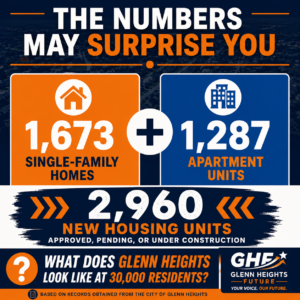
Glenn Heights Future pulled the numbers directly from the city via an open records request. There are 1,673 single-family lots and 1,287 multifamily units, all of which are approved, pending, or already under construction. Add it all up, and you get just under 3,000 homes on the way, on top of a current population of 21,510 (the population according to the American Community Survey (ACS) data).
If every one of those units gets built out, the city could be looking at over 30,700 residents; close to a 40% jump from where Glenn Heights stands today.
Here’s the question nobody’s answered yet: With that many new neighbors on the way, what’s the plan for where they shop, eat, and run errands without having to leave city limits to do it?
What’s actually been approved so far?
Single-Family Residential
- Maplewood 2 – 240 homes (Under Construction)
- Hampton Park – 290 homes (Under Construction)
- Bridges at Little Creek – 110 homes (Pending)
- Bear Creek Elegance – 70 homes (Pending)
- Stewart Farms – 347 homes (Under Construction)
- Maplewood South – 75 homes (Under Construction)
- Meadows at Bear Creek – 52 homes (Pending)
- Valencia Estate – 402 homes (Pending)
- Westmoreland Estates – 73 homes (Pending)
- 221 W. Bear Creek – 14 homes (Pending)
Total Single-Family Homes: 1,673
Multifamily Residential
- Valencia Estate Apartments – 400 units (Pending)
- 1215 Crossing – 216 units (Pending)
- Uhl Crossing – 336 units (Pending)
- Westmoreland Estates – 335 units (Pending)
Total Multifamily Units: 1,287
Combined, that’s 2,960 housing units either approved, pending, or under construction.
Questions Worth Asking
For years, residents have asked for a grocery store, more restaurants, additional retail options, and more places to shop close to home. Yet residential growth continues moving forward at a rapid pace.
That raises several important questions:
- Is commercial development keeping pace with residential development?
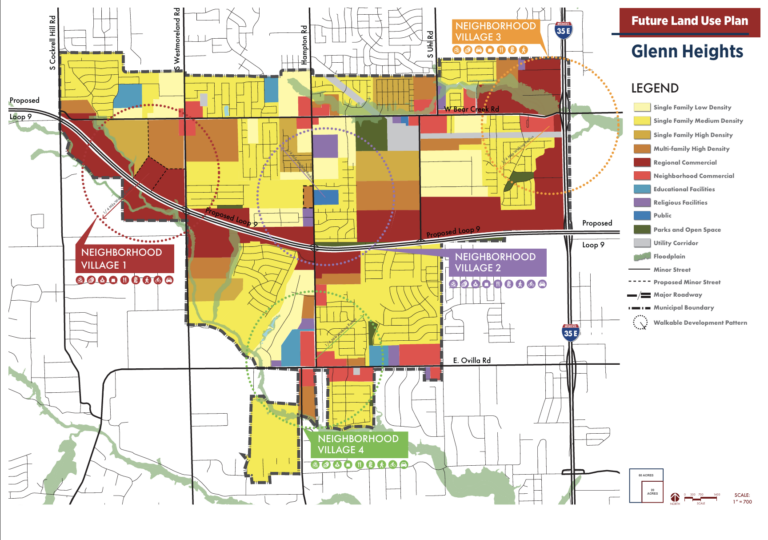
- How much commercially zoned land remains available in Glenn Heights?
- How much of the city’s remaining undeveloped land is already committed to residential projects?
- What happens to traffic, water, wastewater, parks, and public safety as the city approaches 30,000 residents?
- If Glenn Heights reaches 30,000 residents, will residents still need to leave the city for basic shopping and services?
- What is the city’s plan for attracting grocery stores, restaurants, retail, and employers that can support this growth?
A Look Back At 2019
On June 4, 2019, the Glenn Heights City Council considered Agenda Item 6 regarding food service options for residents. Councilwoman Shaunte Allen introduced the item directing the City Manager to move forward with exploring a food co-op concept. The item was approved.
Two weeks later, on June 18, 2019, Councilwoman Allen introduced Agenda Item 5, which would have directed the City Manager to expand efforts to recruit a full-service grocery store while continuing to evaluate the food co-op option. According to the official meeting minutes, then Councilwoman Sonja Brown voted against the measure. The motion failed.
The vote is notable because grocery access continues to be one of the most frequently discussed quality-of-life issues in Glenn Heights today.
2026
The discussion today isn’t about being for or against growth. Growth is coming, and much of it has already been approved.
The real question is what Glenn Heights looks like when these nearly 3,000 housing units are complete.
Will commercial development catch up? Will the city become a place where residents can live, shop, dine, and work closer to home, or will Glenn Heights continue to grow primarily as a residential community while commercial opportunities lag?
One thing is certain: based on the city’s own records, the decisions shaping Glenn Heights’ future are being made right now.
Read More: Is Glenn Heights’ Water Infrastructure Ready for Future Growth?