GLENN HEIGHTS — Officials have clarified that while several significant steps have been taken toward a proposed Glenn Heights data center, additional development reviews remain before construction can begin.
Mayor Sonja Brown addressed the issue in a social media post over the weekend, responding to a question she said she has frequently received: “Has the City already approved the data center?”
“The short answer is no,” Brown wrote.
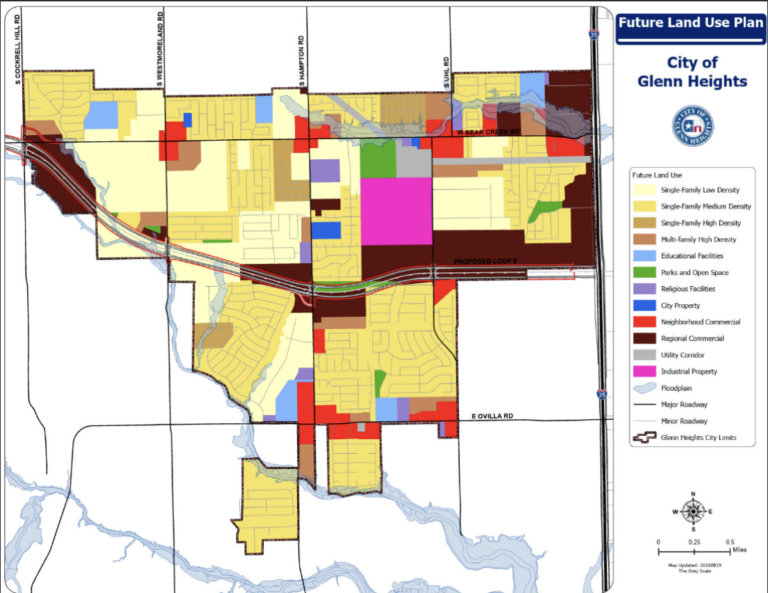
Brown said the Glenn Heights City Council rezoned the property to Planned Development 30 in October 2024 and entered into an economic development agreement with AMF Mission Critical, the developer proposing the project.
She also said the rezoning was not the final approval for construction.
According to Brown’s post, the developer must still submit a detailed site plan, which will undergo additional review as part of the city’s development process. Depending on the final plans and infrastructure improvements, she wrote, additional review by the Planning and Zoning Commission and consideration by the City Council may also be required.
The explanation prompted further questions from residents online.
One resident responded that the public deserved “the complete record, not just part of it,” pointing to the Chapter 380 Economic Development Agreement and the financial incentives and developer commitments it contains.
Another asked how residents could prevent the project “from finalizing.”
Other commenters questioned whether residents had received enough information about the project before previous City Council actions.
Those comments do not necessarily represent the views of the broader Glenn Heights community, but they illustrate the different questions residents are asking about what has already happened and what remains.
The city’s signed Chapter 380 Economic Development Agreement provides additional details.
The city approved more than a zoning change
In October 2024, the City Council approved the rezoning of the property to Planned Development 30.
The city also entered into a Chapter 380 Economic Development Agreement with AMF Mission Critical.
The agreement specifically defines the property’s “Required Use” as a “functioning and operating data center.”
Among the conditions listed for the first economic development grant is “City Approval.”
Under that provision, the agreement states:
“The City Council of the City of Glenn Heights, Texas has, by resolution, approved this Chapter 380 Economic Development Agreement and the related project.”
Separately, Brown’s post identifies additional development steps that remain, including submission of a detailed site plan and further review through the city’s development process.
The records therefore describe several different actions and stages associated with the proposed development.
What does the $15 million incentive mean?
The economic development agreement establishes a city incentive that has become a significant part of the public discussion surrounding the project.
The agreement defines the “Grant” as a total amount not to exceed $15 million.
The document does not describe an upfront $15 million payment to AMF.
Instead, the agreement provides for annual economic development grants generally equal to 50% of the city ad valorem taxes assessed and collected against eligible property, subject to the conditions contained in the agreement and its overall limit.
The agreement itself provides an illustration of how the calculation would work.
It states that if completion of construction occurred in 2028 and city property taxes assessed and collected against eligible property for tax year 2029 totaled $4.2 million, the first annual grant would equal $2.1 million.
The example assumes the other requirements for payment have been satisfied.
The agreement also states that the city’s obligation to pay a grant is contingent upon the city’s timely receipt of the applicable property taxes for that year.
What does AMF have to provide?
The agreement lists several conditions associated with the first grant payment.
Among them are purchase of the property and completion of construction of the Phase 1 building.
The agreement also includes a capital investment requirement.
“Capital Investment” is defined as a monetary investment by the company through cash, assets or loans to purchase the property and construct or install Phase 1 improvements in an amount not less than $250 million.
The agreement says AMF is to provide the city with invoices or receipts and other requested information documenting that investment after completion of construction.
The agreement also calls for a $1 million cash donation to the city for park purposes within 30 days after completion of construction.
Another provision calls for a 10-foot-wide shared-use pedestrian and bicycle trail along the southern and western boundary of the property.
Those provisions are among the conditions identified in the agreement for the city’s first grant payment.
Uhl Road is also part of the agreement
The Chapter 380 agreement also contains provisions addressing improvements to Uhl Road.
The document describes AMF as initially responsible for designing, permitting and constructing improvements to South Uhl Road from Bear Creek Road to Heartland Drive.
The agreement estimates the cost of the Uhl Road improvements at $15 million.
It says the city is to provide reasonable assistance with right-of-way acquisition and permitting review at no cost to the company. It also states that no city review fees will be incurred and that inspection fees associated with the project are city expenses.
The agreement states that costs exceeding the estimated $15 million for the Uhl Road improvements are to be the company’s responsibility.
What about the additional data center buildings?
The agreement contains another provision that has become particularly relevant as the proposed project’s scope has been discussed publicly.
Conceptual plans associated with the development depict multiple buildings.
However, the Chapter 380 agreement states:
“Nothing herein requires the construction of any vertical improvements other than the Phase 1 Building notwithstanding the depiction of additional improvements on the PD Concept Plan.”
The agreement’s language concerning Phase 1 is relevant to that discussion because the document itself expressly addresses whether additional vertical improvements depicted on the concept plan are required under the agreement.
Glenn Heights Future is not making a determination about how any change in the project’s scope affects other city approvals, requirements, or provisions of the agreement.
The agreement includes access through Heritage Park
The Chapter 380 agreement also contains provisions involving Heritage Park.
It grants the company a license to use a minimum 50-foot-wide continuous construction-access corridor through Heritage Park, from Bear Creek Road to the property’s northern boundary.
According to the agreement, use of the corridor begins when the Phase 1 building permit is issued.
The document states that the purpose of the corridor is to provide construction access to the property while avoiding use of South Uhl Road.
It also says AMF is to return the corridor to its existing condition when its use ends.
No permanent improvements — including utilities, access, drainage or similar improvements — are permitted within the construction corridor under the agreement.
What does the agreement say about termination?
Some residents have also asked whether the city’s economic development agreement with AMF can be canceled or revoked.
The agreement contains provisions addressing termination.
Among them are termination by mutual written agreement of the parties and circumstances involving a default or breach that is not cured within the period specified in the agreement.
The document also identifies circumstances involving acquisition of the property and completion of construction.
The agreement separately describes payments involving Uhl Road improvement costs under certain circumstances following termination.
Whether any termination provision applies to the project’s current circumstances is a legal question that Glenn Heights Future is not attempting to answer.
So, what has happened, and what remains?
The documents and the city’s recent statements provide a clearer picture when viewed together.
The City Council rezoned the property to Planned Development 30.
The city entered into a Chapter 380 Economic Development Agreement with AMF Mission Critical.
That agreement defines the required use as a functioning and operating data center, establishes a potential economic development grant of up to $15 million subject to its terms and conditions, and contains provisions addressing the company’s investment, park contribution, trail construction, Uhl Road improvements and construction access through Heritage Park.
The agreement also states that the City Council approved the Chapter 380 agreement “and the related project.”
At the same time, Brown says additional development steps remain.
Those include submission of a detailed site plan and additional review through the city’s development process, with possible additional Planning and Zoning Commission review and City Council consideration depending on the final plans and infrastructure improvements.
The distinction matters because the question “Has the data center been approved?” attempts to reduce a multistep development process to a yes-or-no answer.
The public records instead document actions that have already occurred alongside additional steps that have not.
That distinction was also at the heart of residents’ comments over the weekend.
One resident argued that meeting legal notification requirements was different from “meaningfully informing the community,” saying residents should have received broader information about a project with potential long-term effects.
Another resident, who said the proposed development would be behind their home, wrote that they moved to the area because they enjoyed listening to birds and other sounds associated with the area’s quieter surroundings and worried the development would change that.
Whether residents support or oppose the proposed data center, understanding the process requires distinguishing between actions already taken and actions that remain.
The city’s own records show that Glenn Heights has already rezoned the property and entered into a detailed economic development agreement specifically addressing a data center project.
The city’s mayor, meanwhile, says additional site-plan and development reviews remain before construction can begin.
Both are parts of the public record, and both are necessary to understand where the proposed project stands today.
Follow the full project: See GHF’s Glenn Heights Data Center timeline, Chapter 380 agreement, source documents and continuing coverage: www.glennheightsfuture.com/data-center