Updated 1:42 p.m. July 22, 2026 – this story has been updated to clarify the timeline of resident opposition and to note which claims have not been independently verified.
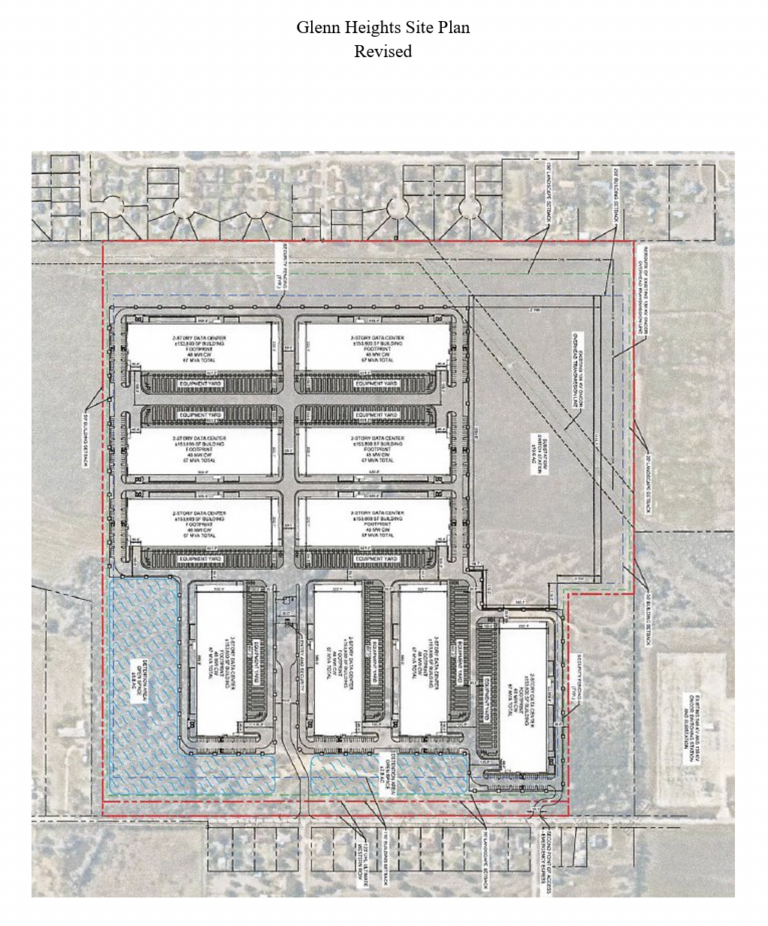
GLENN HEIGHTS — Plans for the proposed Glenn Heights Data Center took a notable turn Tuesday night as city leaders revealed the project’s initial phase has been scaled back from nine buildings to a single facility — a change that prompted questions from Glenn Heights City Council members about communication, transparency, and the project’s long-term future.
The new approach also produced one of the evening’s most memorable moments.
“We think that once we get one building and see how much you like it, we might do more,” developer Atkins told the council. “We’re gonna do that in partnership with you.”
The comment came after Councilman Tramayne Hobbs questioned why the council had not been informed sooner that the developer’s plans had changed.
“With you changing your plan from nine buildings to one building, I think you should probably inform your entire council instead of just one person about what you’re doing,” Hobbs said.
Mayor Sonja Brown responded that she had asked the developer questions while preparing for Tuesday’s presentation and learned of the revised plan during those discussions.
“I get that,” Hobbs replied. “I think you should share with everybody, as we’re all decision makers in this aspect of this, although this has already been approved.”
The developer explained that Phase One now focuses on approximately 140 acres and a single building, rather than the original concept of nine buildings.
Mayor outlines project history
Brown opened the discussion by reviewing the nearly nine-month zoning process that ultimately resulted in the property being rezoned from residential to commercial in 2024.
“Over the past several weeks, we’ve heard a lot,” Brown said. “I’ve spent some considerable time educating myself on this topic, meeting with the developer at the TACO About It Town Hall, asking some follow-up questions of him, and I’ve had an opportunity to speak with City Staff. I’ve reviewed our zoning process, and I’ve asked questions so I can make informed decisions; and I want to say the previous council did the same.”
Brown emphasized that the proposed facility is intended to be a cloud data center and explained that cloud computing already supports services residents use every day.
“The developer proposing a project in Glenn Heights, AMF Mission Critical, has informed the city that the facility they intend to construct is a cloud data center,” she said.
Referencing the June town hall meeting, Brown recalled the developer asking attendees who owned a cellphone and who used Google Maps.
“That’s cloud,” Brown said. “That is a cloud-based service.”
Brown also told residents that the revised development plan demonstrates how projects evolve over time.
“While the original concept anticipated constructing nine buildings during the initial phase of development, please hear me, AMF’s current plan is to construct only one building during phase one,” she said. “I think that’s important information for our residents to hear, because development can and often do evolve as market conditions, customer demand, and business needs change.”
“It also demonstrates why it is important for us to continue asking the questions, and sharing updated information with our community in healthy dialogue,” Brown said.
“Moreover, I also appreciate that Mr. Atkins and his team have continued to engage with our community, and they keep us informed as their plans evolve.”
Tax value and zoning timeline
Brown also highlighted the property’s current tax status.
“The property currently has a market value of approximately $3 million; however, because it is currently receiving an agricultural exemption valued at approximately $2.976 million, its taxable value is only about $24,000,” Brown said. “Our homes are worth a fraction of that, and our taxable value is a lot more than $24,000.”
She added that the property generated only $557.30 in property taxes during the 2025 tax year, of which Glenn Heights received approximately $135. (These figures were provided by Brown during the meeting; Glenn Heights Future has not independently verified them against Dallas County Appraisal District or Ellis County records.)
“Whether one supports or opposes future development of this property, I believe it is important that we all begin our discussion with the same factual understanding of where the property stands today,” Brown said.
The mayor then walked through the zoning process, beginning with staff meetings in January 2024, continuing through Planning and Zoning hearings in July 2024 and City Council consideration in August before final approval in October 2024.
“This process did not appear before council overnight,” Brown said. “It followed a process. It was open, it was transparent, and it was not done on the down low.”
Brown also reminded residents that approval of the zoning ordinance was not the final step. A detailed site plan must still be reviewed by the Planning and Zoning Commission before returning to the City Council for approval.
Power availability drives revised plans
Atkins said the change is being driven partly by electrical infrastructure realities.
“We have a better chance of getting a smaller amount of power from ERCOT than the big load we had been pursuing,” Atkins said, citing transmission congestion in southern Dallas County.
Atkins said the shift to a single building was also shaped by opposition voiced at the June town hall meeting, distinct from the questions raised by council members Tuesday night.
“When I attended the last town hall meeting and saw the pushback, I thought, well, maybe this makes sense to start slow, let everybody get acclimated to what we’re doing, rather than I’m going to start putting a shovel in the ground for nine buildings,” Atkins said.
He said the revised strategy also aligns with the amount of electrical service likely to become available.
Atkins added that while the company originally envisioned developing the entire 300-acre site, that outcome is now considered unlikely.
The company intends to focus on the first 140 acres for the foreseeable future while retaining the right of first refusal should portions of the remaining property become attractive for retail or other commercial development.
Council raises community concerns
Hobbs also questioned whether limiting public outreach to property owners within 200 feet of the project was sufficient.
“I don’t think the people that are saying something now are just within those 200ft; it’s the entire city,” he said.
Atkins responded that the company followed the notification requirements associated with zoning cases. Brown said broader notification may be something the city should consider in the future.
Councilmembers Laymon Lightfoot and Nelda Washington questioned the developer about water consumption.
Atkins said the facility will utilize a closed-loop cooling system and said the project’s water use will not affect Glenn Heights residents. (This claim has not been independently verified.)
Lightfoot also confirmed with the developer that electricity costs associated with the data center cannot be passed on to local residents.
“That’s coming straight from the Governor down,” Atkins said, attrubuting the restriction on passing costs to residents to state-level policy. (Glenn Heights Future has not independently confirmed the specific statute or PUC rule referenced.)
Washington later questioned whether previously discussed incentive payments would change now that only one building is planned initially.
Following a tense exchange between Brown and Washington regarding the discussion, city officials confirmed the previously discussed $1 million incentive payment to the city remains unchanged.
Construction timeline
Councilman Travis Bruton asked about construction timing.
Atkins said the company hopes to begin construction by the end of next year if electrical service is approved before the end of this year.
Construction of the first building is expected to take approximately 14 to 16 months, with improvements to UHL Road occurring during that same timeframe.
The developer also told council members the company typically sells completed data centers, although the same end user generally remains in the facility.
Community tour planned
Brown announced the city is working with the developer and DART to organize a community visit to a cloud data center in Richardson.
While security restrictions will prevent residents from entering the facility, attendees will be able to observe the exterior and evaluate operational noise levels. The mayor said she hopes to schedule the trip on a Saturday, with additional information to be released later.
Any future modifications to the approved development will require review by both the Planning and Zoning Commission and the City Council.
Glenn Heights Future has submitted a Texas Public Information Act request seeking the project’s Chapter 380 agreement, financial documents related to the incentives, and records showing whether current or former members of the City Council signed any nondisclosure agreements related to the project.
This is a developing story.