GLENN HEIGHTS, Texas — Glenn Heights Mayor Sonja Brown has spent the past year at the center of a series of political controversies, disputes and questions that, when considered individually, could probably be explained. Taken together, the picture becomes more complicated.
A mayoral appointee later ran for City Council and faced questions about his residency. An email exchange with a resident moved from electoral preferences to whether the resident’s organization could continue using a building for free. Brown has promoted commercial development and recalled campaigning for a grocery store, although her voting record includes opposition to a measure that would have expanded the city’s search for one. Brown has made transparency and public accessibility part of her message, while extensive public discussion about one of the city’s most consequential development proposals came nearly two years after significant city action involving the project. Political disagreements with a council member have also become increasingly visible.
No single episode establishes misconduct by Brown, and Glenn Heights Future is not alleging corruption or illegality. Some episodes may have reasonable explanations. Others may amount to nothing more than the messy nature of local politics.
Their frequency still matters.
Brown has repeatedly found herself at the center of unusual political disputes and questions involving political relationships, development, transparency and interactions with other elected officials. Residents can evaluate each episode individually, but they can also consider what those episodes collectively say about leadership at City Hall.
The question is not whether one controversy proves something about the mayor. The question is why so many controversies have required an explanation and whether the continuing political friction benefits the residents Brown was elected to serve.
Marcel Howard’s candidacy raised questions
Questions surrounding Marcel Howard became one of the more unusual political stories of 2025. Brown appointed Howard to the city’s Charter Review Committee before Howard subsequently became a candidate for City Council Place 4.
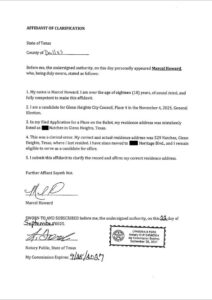
Howard’s candidacy later generated questions about his residency. A notarized affidavit dated Sept. 22, 2025, acknowledged that the residence address listed on Howard’s original ballot application was incorrect. Howard described the discrepancy as a “clerical error,” identified 529 Natchez as his “correct and actual residence address” and described that location as the place where he “last resided.” Howard said he had since moved to an address on Heritage Boulevard.
Brown addressed their relationship during a fall 2025 City Council meeting after Howard’s residency became a significant election issue. Brown acknowledged having taken Howard home on an occasion but indicated that she did not know him particularly well.
Howard’s own social media history provided additional context. Howard had previously thanked Brown for providing him a volunteer opportunity, called her his “favorite mayor,” thanked her for “always showing up” when he asked and said he had served as security for Brown during Harris-Walz campaign activity in Pittsburgh.

Those posts document a relationship between Brown and Howard that predated his council candidacy.
The resulting sequence was unusual. Brown appointed Howard to a city committee, Howard became a council candidate, questions emerged about his residency, and his previous interactions with Brown became part of the public discussion surrounding his candidacy.
None of those facts establishes misconduct. They document a political controversy that became part of the 2025 election.
An email to Jana Weaver raised another question
Another unusual episode occurred during the 2025 election through an email exchange between Brown and Glenn Heights resident Jana Weaver.
Weaver told Brown that she supported the mayor but did not support Howard. Weaver cited concerns about Howard’s multiple addresses and wrote that elections and candidate qualifications should be held to “the highest level of integrity.”
Brown’s response addressed what Weaver’s position appeared to suggest about her political alignment.
“Your comment makes it seem like you support Tate’s (his) council bot the current (this) council,” Brown wrote.
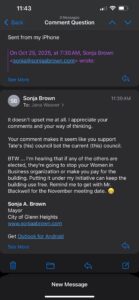
Brown then raised Weaver’s Women in Business organization. Brown said she had heard that the election of other candidates could result in the organization losing free use of a building or being required to pay for it.
“Putting it under my initiative can keep the building use free,” Brown wrote.
The email does not establish that Brown conditioned continued free use of the building on Weaver’s political support, and GHF is not alleging that she did.
The written exchange still raises a reasonable question. A resident told the mayor which candidates she supported. Brown responded by discussing what those choices appeared to say about the resident’s political alignment and then discussed how placing the resident’s organization under “my initiative” could keep its building use free.
GHF cannot know Brown’s intent from the email alone and will not speculate about it. Residents can read the words themselves and decide whether they believe electoral politics and the organization’s building arrangement belonged in the same conversation.
The record on commercial development and a grocery store
Brown has also become a vocal supporter of additional commercial development in Glenn Heights, including the grocery store residents have requested for years.
Brown said during a June joint meeting of the City Council and Planning and Zoning Commission that she and Councilwoman Shaunte Allen campaigned in 2018 on bringing a grocery store to Glenn Heights.
The subsequent voting record presents a more complicated history.
Allen introduced an item June 4, 2019, directing the city manager to move forward with a food co-op concept. The council approved the measure. Allen returned two weeks later with another item that would have directed the city manager to expand the search for a full-service grocery store while continuing to evaluate the food co-op option.
Brown voted against that measure. The motion failed.
One vote does not establish that Brown opposed bringing a grocery store to Glenn Heights. Council members can support the same goal while disagreeing about how the city should pursue it. Positions and circumstances can also change over time.
The vote becomes relevant because Brown has cited her 2018 campaign as evidence of her longstanding pursuit of a grocery store. Allen’s subsequent council action sought to expand that pursuit. Brown’s recorded vote went the other direction.
The broader development record raises similar questions.
“We decided to change zoning and not stick to what we said the future land use was going to be,” Kelley said. “Zoning and the future land use need to say the same thing.”
Kelley described a pattern spanning years rather than one isolated decision.
Brown did not create that history alone. Successive councils and planning commissions shaped the Glenn Heights that exists today. Several members of the current council were not in office when many of those decisions occurred.
Brown nevertheless has served longer than any other current elected official. The city says Brown was first elected to the council in 2018 before later serving as mayor pro tem and winning the mayor’s office in 2022. Her tenure makes the historical record relevant when she discusses the commercial development Glenn Heights needs today.
Residents can support Brown’s current push for grocery stores, restaurants, retail and other commercial development while still asking why those amenities failed to keep pace with residential growth during years when she helped govern the city.
Brown emphasizes transparency. The data center tests it.
Brown has made transparency and accessibility visible parts of her approach to the mayor’s office.
“Miles With the Mayor,” held when weather permits, gives residents an opportunity to walk with Brown and discuss city issues. The concept provides residents direct access to their mayor, and efforts that make elected officials more accessible deserve recognition.
The proposed Glenn Heights data center provides a more complicated test of transparency.
The City Council took significant action involving the project in October 2024, including rezoning property for a data center and electrical substation and approving a Chapter 380 economic development agreement involving AMF Mission Critical.
The widespread public debate familiar to many residents today emerged much later. Residents began asking extensive questions about the previous approvals, the project’s scale and its potential effects during the summer of 2026.
Brown has since devoted substantial attention to explaining the project. Her mayoral social media page has featured an extensive series titled “Understanding Data Centers: Facts. Process. Community.” The posts have addressed water, wildlife, stormwater, noise, traffic, construction, buffering and other issues.
Much of Brown’s material is measured. She has acknowledged unanswered questions, distinguished earlier city actions from development reviews that remain and described the series as an educational effort rather than an attempt to tell residents what they should think.
More information is better than less information. The timing nevertheless raises a fair question about Brown’s emphasis on transparency.
Significant city action occurred in 2024. The extensive public education effort followed after residents began raising substantial questions in 2026.
Transparency does not mean every resident will know about every agenda item or understand every technical development agreement before a vote. Residents also bear some responsibility for following their local government.
Meaningful transparency, however, can involve more than making documents legally available. Major decisions can benefit from clear public communication while residents still have an opportunity to understand what their government is considering.
The data center therefore presents a contrast with Brown’s transparency message. Residents have received considerably more information since they began demanding answers, but many of their questions concern decisions City Hall made nearly two years earlier.
GHF is not alleging that the 2024 votes were improperly posted, conducted secretly or otherwise violated public-meeting requirements. The question is narrower: Why did the extensive effort to explain one of the largest development proposals in Glenn Heights come after residents began questioning what had already happened rather than while those consequential decisions were being considered?
Political Disagreement With Nelda Washington
Political disagreement between Brown and Councilwoman Nelda Washington has become increasingly visible during 2026. Brown has questioned Washington during council proceedings – most recently regarding power outages by a CoOp in the city, and disagreements between the two have occasionally become part of the public conversation surrounding City Hall.
Their recent disagreement involving Washington’s proposal concerning traffic on Gateway Boulevard at Bear Creek Road demonstrates that disagreement itself is not the problem. GHF examined Washington’s proposal and concluded that Brown raised legitimate concerns. Our coverage said so.
Public officials are supposed to challenge proposals they believe are flawed. Council members should be able to question one another, debate policy and cast opposing votes without disagreement becoming evidence of dysfunction.
Washington has now publicly described another interaction with Brown. In a social media post, Washington said Brown confronted her in the City Hall parking lot after the Sept. 8 council meeting. Washington said the conversation continued past midnight and involved Brown’s concerns about Washington’s comments and questions during previous meetings.
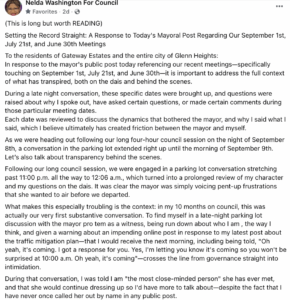
Washington also said Mayor Pro Tem Travis Bruton was present.
GHF is intentionally not detailing the additional accusations made in Washington’s post here. The parking lot encounter is not the central issue presented in this examination. Its relevance comes from its place in a longer period of increasingly visible political friction involving the mayor.
The episode adds another public dispute to a year already filled with them.
What does the cumulative record show?
Each episode has limitations as evidence of anything larger. Howard’s social media posts document previous interactions but do not establish the nature or closeness of his relationship with Brown. Brown’s email to Weaver does not establish that a benefit was conditioned on political support. A 2019 grocery store vote does not establish opposition to grocery stores. Years of zoning decisions cannot fairly be attributed to one elected official. Increased communication about the data center is not evidence of wrongdoing. Washington’s description of the parking lot encounter represents her account of the event.
Those distinctions matter.
The accumulation matters, too.
Brown has repeatedly found herself at the center of questions involving political relationships, electoral loyalties, development decisions, transparency and relationships with other elected officials. Residents do not need to conclude that something improper happened during each episode to consider what the episodes collectively say about the political environment at City Hall.
Reasonable explanations may exist for many of them. Brown and Howard may simply define the extent of their relationship differently. The Weaver email may have conveyed an implication Brown never intended. Brown’s approach to commercial development may have evolved. The data center communication campaign may represent a genuine effort to provide information after residents demonstrated that they wanted more of it. Council disagreements may reflect nothing more than elected officials debating consequential issues.
Those possibilities deserve acknowledgment.
The frequency of the disputes nevertheless has become part of the story.
Glenn Heights faces bigger problems
Glenn Heights could perhaps afford endless political theater if nothing consequential were happening.
The city does not have that luxury.
Nearly 3,000 additional housing units have been identified in various stages of the development pipeline. Roads, drainage, water infrastructure and public safety must keep pace with continued growth. Glenn Heights also has a finite amount of undeveloped land remaining for the commercial development residents have requested for years.
Those challenges require policy decisions that will affect Glenn Heights long after today’s political arguments disappear from social media.
They also require a functioning City Council.
Glenn Heights has a council-manager government, not a strong mayor
Glenn Heights’ governmental structure provides important context for evaluating the political environment surrounding Brown.
The city does not operate under a strong-mayor system. Glenn Heights uses a council-manager form of government. The mayor and six council members collectively constitute the city’s governing and lawmaking body, according to the city. The city manager serves as the chief administrative officer responsible for city administration.
Brown occupies an important position. She presides over meetings, represents the city in numerous settings and possesses a highly visible public platform.
Brown does not govern Glenn Heights alone. No council member does.
The system depends on seven elected officials who can disagree, vote and continue working together. The system also depends on appropriate distinctions among politics, policymaking and professional administration.
Political disagreement is unavoidable. Political dysfunction is not.
Why so many controversies?
No single episode from the past year answers that question. No document establishes that one motivation connects these events, and GHF is not making that claim.
The record instead presents a collection of separate episodes involving the same public office.
A mayoral appointee became a council candidate, and his residency became controversial. His previous interactions with the mayor subsequently became part of the public discussion.
A resident expressed her electoral preferences and received a response discussing political alignment and the continued free use of a building by her organization.
The mayor invoked her history of campaigning for a grocery store, while the historical record included her vote against expanding the city’s search for one.
A longtime planning commissioner acknowledged that zoning decisions repeatedly departed from the city’s Future Land Use Map during a period spanning multiple councils.
A mayor who emphasizes transparency has spent considerable time explaining a data center project since residents began asking questions during the summer of 2026, although significant city action involving the project occurred in 2024.
Political friction with another council member has repeatedly surfaced in public, followed most recently by Washington’s account of a late-night conversation outside City Hall.
Any one of those episodes can be considered individually. Their recurrence makes the cumulative record a legitimate subject for public examination.
That examination does not require residents to conclude that Brown is corrupt, dishonest or unfit for office. It does not require residents to side with Washington, Howard, Weaver or anyone else involved.
It requires residents to look at the record and decide what they expect from their mayor.
GHF has criticized Brown when our examination of the record warranted criticism. GHF has also sided with Brown when our examination supported her position, including the recent Gateway Boulevard dispute. Accountability loses its value when it becomes a team sport.
Glenn Heights does not need seven elected officials who always agree. The city needs seven elected officials capable of governing together after they disagree.
Residents need infrastructure that works, wastewater they can afford, responsible development, a stronger commercial tax base and a city government capable of managing extraordinary growth.
Those challenges are considerably more important than another political feud.
The past year does not present one scandal that explains everything about Brown’s leadership. It presents a collection of unusual episodes, contradictions and conflicts involving the same office.
Residents can decide what that cumulative record means.
City Hall has a more immediate responsibility. Glenn Heights has serious work to do, and its residents deserve a government focused on doing it.