GLENN HEIGHTS – Nearly a year after voters approved changing Glenn Heights City Council elections from majority to plurality voting, the city’s former attorney has concluded that the Texas Constitution requires the city to continue electing its governing body by majority vote.
The legal opinion came after Glenn Heights resident Tiina Arjanen questioned whether the charter amendment approved by voters in November 2025 could legally apply to a city whose council members serve terms longer than two years.
Former City Attorney David Berman agreed with Arjanen on that issue.
“The majority vs. plurality issue is, I believe, legitimate,” Berman wrote in an opinion forwarded by City Manager Clifford Blackwell on Aug. 21.
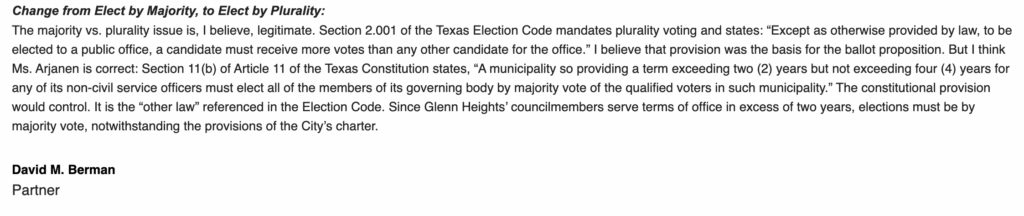
Berman pointed to Section 2.001 of the Texas Election Code, which generally provides that a candidate is elected by receiving more votes than any other candidate unless otherwise provided by law.
He then identified the provision he believes controls in Glenn Heights.
“I think Ms. Arjanen is correct,” Berman wrote.
“The constitutional provision would control,” he continued. “It is the ‘other law’ referenced in the Election Code.”
Berman concluded that because Glenn Heights council members serve terms exceeding two years, city elections “must be by majority vote, notwithstanding the provisions of the City’s charter.”
Voters approved plurality voting in 2025
Berman’s conclusion creates an unusual situation for Glenn Heights.
Voters approved a charter amendment in November 2025 changing elections for mayor and City Council from majority to plurality voting.
Under plurality voting, the candidate receiving the most votes wins, even without receiving more than 50% of the vote. Under majority voting, a candidate must receive more than 50% to win, potentially requiring a runoff when no candidate reaches that threshold.
The voter-approved plurality provision remains in the city charter. Berman’s opinion, however, concludes that it cannot override the majority-vote requirement contained in the Texas Constitution.
The opinion does not constitute a court ruling invalidating the charter provision. It does provide the city with a legal conclusion from its former attorney that the constitutional requirement controls regardless of what the charter currently says.
That leaves questions about how future Glenn Heights elections will be conducted and what, if anything, the city will do to address the conflicting charter language.
Resident questions review before election
Arjanen said her questions began after noticing that most governmental entities in the area continue to elect officials by majority vote despite the additional cost of runoff elections. That prompted her to research why plurality voting was not more common.
After reviewing Berman’s opinion, Arjanen said she was pleased that his conclusion aligned with the Texas Constitution.
When asked whether she believed the plurality amendment should have been placed on the ballot, Arjanen replied, “No, I do not.”
She questioned why the constitutional conflict was not identified during the legal review before the proposition reached voters. She also believes the Charter Review Committee had a responsibility to review and research applicable constitutional and statutory requirements as part of its work before recommending proposals to the City Council.
Arjanen said the issue raises broader concerns about the process used to develop and review the charter amendments before they were presented to voters.
She also believes the city should formally correct the plurality language in the charter rather than leave a provision in place that Berman has concluded cannot supersede the Texas Constitution.
The distinction leaves voters in an unusual position. They approved the proposition presented to them in November 2025, but the legal opinion obtained nearly a year later concludes that the resulting charter provision cannot govern Glenn Heights elections.
That shifts the unanswered question away from how residents voted and toward the process that occurred before the proposition ever appeared on their ballots.
How did the proposition reach the ballot?
Following receipt of Berman’s opinion, Glenn Heights Future sent Blackwell two follow-up questions.
The first asked what legal review was conducted before the plurality amendment was placed on the November 2025 ballot, particularly regarding the majority-vote requirement Berman identified.
The second asked whether, based on Berman’s opinion, the city anticipates taking action to address the plurality language currently in the charter or whether the issue will instead be addressed when future elections are conducted.
No response to those questions had been received as of publication.
Berman’s opinion does not identify who reviewed the plurality proposal for constitutional compliance before the election or explain how the conflict went unidentified before the proposition was submitted to voters.
Blackwell did respond to Arjanen’s original inquiry and forwarded it for legal review, resulting in Berman’s opinion.
Attorney rejects other challenges
Berman did not agree with every concern Arjanen raised regarding the 2025 charter election.
Arjanen questioned whether petition signatures were required before charter amendments could be placed before voters.
Berman rejected that argument, citing Section 9.004 of the Texas Local Government Code.
He wrote that state law provides two methods for submitting charter amendments. A city governing body may submit an amendment to voters on its own motion. A qualifying citizen petition, meanwhile, requires the governing body to call an election.
“Absent a petition, the council may call for an election but it doesn’t have to,” Berman wrote.
Berman also rejected a challenge involving a charter provision allowing the City Council to appoint a council liaison. He concluded that the charter does not prohibit the council from compensating a person serving in that position.
His conclusion regarding plurality voting was different.
On that issue, Berman agreed with Arjanen that the Texas Constitution controls.
What happens before the next election?
The opinion leaves Glenn Heights with a voter-approved charter provision calling for plurality elections and a constitutional provision that Berman says requires majority elections.
It also leaves unresolved what the city will do with the conflicting charter language.
Arjanen believes it should be formally corrected.
Berman’s opinion provides a clearer answer about how elections must be conducted while Glenn Heights council terms remain longer than two years.
“Elections must be by majority vote,” he wrote, “notwithstanding the provisions of the City’s charter.”
Glenn Heights voters answered the question placed before them in November 2025.
Nearly a year later, the legal opinion obtained after a resident questioned the amendment has raised another:
How did a plurality-voting proposition that the city’s former attorney now says cannot override the Texas Constitution make it onto the ballot in the first place?