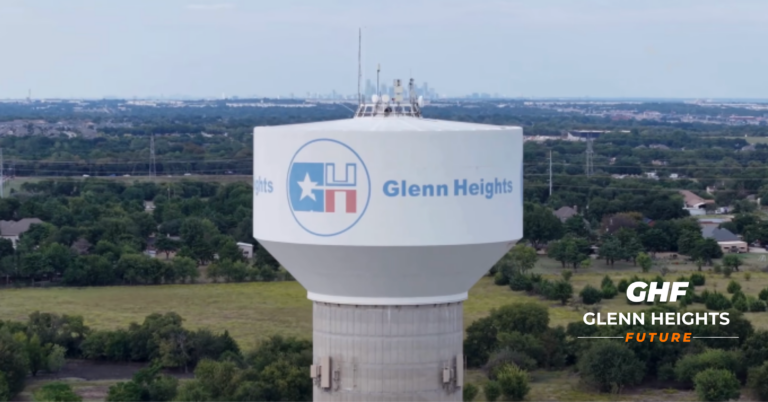
GLENN HEIGHTS – After years of growth, Glenn Heights officials are facing a new fiscal reality: More development is generating additional revenue, but continued growth is also expected to increase demands on public safety, infrastructure and city services, according to the city’s proposed budget. In other words, growth pressures Glenn Heights’ proposed budget.
The proposed fiscal 2026-27 budget calls for a property tax rate of $0.590821 per $100 of assessed valuation, up from $0.562795.
The proposed rate matches the city’s calculated voter-approval tax rate. The no-new-revenue rate, which is intended to produce roughly the same property tax levy from existing properties as last year, is $0.569032.
The proposal would raise $668,048 more in property tax revenue than last year’s budget, about a 6.3% increase, according to the city. Of that, $261,062 would come from newly added properties.
The proposal comes as the city’s certified taxable value increased just 1.25%, from $1.887 billion last year to $1.910 billion this year. City administrators describe that as the lowest growth rate in seven years, although they expect new construction to push values higher in future years.
The numbers raise a key question for this rapidly growing community: Can Glenn Heights’ tax base keep up with the cost of its growth?
Property Taxes Remain The City’s Workhorse
Property taxes are expected to account for 61.2% of General Fund revenue under the proposed budget, making them the fund’s largest revenue source.
In the budget narrative, city administrators project about $16.5 million in General Fund revenue and approximately $16.1 million in expenditures, resulting in a surplus of about $451,000 before transfers. Detailed General Fund tables elsewhere in the proposed budget list slightly different totals.
General fund revenue is projected to increase about 9.1%, which city administrators attribute mainly to development activity driving higher permit and licensing revenue. Expenditures are expected to rise by 2.5%, largely due to personnel changes and higher regional jail costs.
There are signs of growth elsewhere in the revenue picture.
Sales tax collections have grown at an average rate of about 5.7% over the past four years, though city officials say that growth has slowed. The city projects about $1.35 million in sales tax revenue next year.
Permit revenue is expected to increase by 35.2%, with the city citing new subdivisions and increased activity in plan reviews and trade permits.
But the proposed budget also makes clear that development carries costs.
Growth Brings More Demands
Among the city’s stated future challenges is preparing for additional residential development.
The proposed budget says future residential developments will require more staff to meet growing demands for public safety, services and utilities.
It also lists roadway, wastewater and water infrastructure improvements as ongoing needs.
East Bear Creek Road remains under expansion, while the city says planning is increasingly needed for South Hampton and South Westmoreland roads. The city also plans to issue bonds for design work to expand West Bear Creek Road.
Those pressures are already showing up elsewhere in the spending plan.
The city says repairs and maintenance costs have risen as vehicles age. Public works equipment has been out of service often enough that the department has had to borrow from neighboring cities, according to the budget.
The proposed spending plan calls for using fund balance for one-time purchases of heavy equipment.
At the same time, funding for concrete repairs is being cut in half after $250,000 was added as a one-time expense in the current budget. Administrators acknowledge the need to restore that funding remains.
The budget also proposes adding a construction project manager as development increases. That employee and an existing inspector would oversee infrastructure inspections.
Another Financial Pressure Is Coming From Wastewater
Property taxes may not be the only household expense affected by the city’s growing needs.
The Red Oak Creek Regional Wastewater System has notified Glenn Heights of a 54.5% increase in its revenue requirement — about $3 million — due to capital investment in plant expansion.
Glenn Heights Future has submitted an open records request to the Trinity River Authority to better understand our position. As of publishing, no records have been released.
The city included the additional expenditure in its proposed budget but has not increased projected sewer revenue because the City Council has not yet adjusted rates.
The budget is unusually direct about the problem:
The increase, city officials wrote, “cannot be absorbed within the current rate structure.”
As a result, the city says it will review rate changes. Officials are also considering changes to the water rate structure that could separate commercial and residential rates, though no action has been taken.
Ensuring the long-term sustainability of the water and sewer fund through rate adjustments is listed among the city’s future financial challenges.
A Growing City – And The Question Of Who Pays For Growth
None of those figures necessarily mean Glenn Heights is in poor financial condition.
The proposed budget describes the city’s general fund reserve as stable and projects an end-of-year fund balance of approximately $10 million.
Rather, the budget illustrates the balancing act a city faces as it pursues development while trying to maintain roads, equipment, utilities, public safety, and other services.
That distinction matters as Glenn Heights continues to approve and plan new development.
Residential development adds taxable property to the city. It also brings residents who use streets, police and fire services, parks, water and wastewater systems, and other municipal infrastructure.
The city appears to recognize that challenge.
Its proposed budget identifies “anticipating significant growth, while planning for increased service levels” as one of its future considerations. It specifically says future residential development will require more staff for public safety, public services and utilities.
That places greater importance on the type of development Glenn Heights attracts and how effectively new growth expands the city’s revenue base compared to the services and infrastructure it requires.
It also provides financial context for the city’s efforts to attract commercial and economic development.
What Happens Next
The proposed Glenn Heights budget is not final.
According to the city’s budget calendar, the Glenn Heights City Council is scheduled Tuesday, Aug. 4, to receive the no-new-revenue and voter-approval rate calculations and certified property values, consider the tax rate and set public hearing dates.
A formal presentation of the city manager’s proposed budget is set for Saturday, Aug. 8.
Public hearings are scheduled for Sept. 1, with adoption of the budget and tax rate set for Sept. 8. The calendar notes that dates may change.
As council members begin those discussions, the proposed budget frames the challenge ahead.
“The impacts of additional growth and the strains it places on the infrastructure will require the city to re-evaluate its priorities and develop a funding plan to address its needs,” City Manager Clifford Blackwell wrote in the budget proposal.
For Glenn Heights residents, that funding discussion is no longer abstract.
It begins with a proposed higher property tax rate — and the city’s own budget shows that roads, public safety, equipment, wastewater, and continued growth will remain part of the financial conversation long after this year’s tax rate is decided.