There comes a point when public engagement requires more than simply providing residents with information, that’s especially true with the Glenn Heights Data Center.
It requires listening to what they say in return. Glenn Heights may be approaching that point.
For weeks, Glenn Heights Mayor Sonja Brown has published a series about the proposed data center, addressing questions about water, infrastructure and other concerns surrounding the project.
The stated goal is to help residents make informed decisions. Residents appear to be making one. They just may not be making the one Glenn Heights City Hall wants.
On Glenn Heights Future’s Facebook page, an informal poll asked residents whether they supported, opposed or were undecided about the proposed data center. The result: overwhelming opposition from participants.
That is not a scientific poll; it should not be treated as one.
However, dismissing the result as merely the sentiment of this publication’s audience becomes harder when residents are saying much the same thing on the mayor’s own Facebook page.
Residents are questioning water consumption and expressing concerns about electricity, noise and traffic. They are asking what tangible benefits the project provides. Others are simply saying no.
One commenter summed up the frustration with the mayor’s campaign: “We need a FAQ for the FAQ.”
Another described the series as persuasion, not education. That distinction matters.
What happens if the answer is still no?
Government has every right—and an obligation—to correct misinformation.
City officials should explain complicated proposals. Residents should understand the facts before forming conclusions. Elected officials should not govern according to Facebook reactions.
However, public engagement cannot mean explaining something repeatedly until the public finally agrees.
If the mayor’s series is genuinely intended to help residents make an informed decision, City Hall must be prepared for the possibility that an informed community may still oppose the project.
Otherwise, this isn’t a conversation; it’s a sales pitch.
That doesn’t mean the data center is necessarily bad for Glenn Heights; it may offer significant economic benefits. Some concerns raised online may prove unfounded; others may prove legitimate.
Make the case, release the information, answer the questions; then, listen to the answers that come back.
Right now, the loudest message from residents in this debate isn’t difficult to understand. They don’t want to be convinced; they want to be heard.
Then came the decorum notice.
That makes the agenda for Tuesday’s Glenn Heights City Council meeting particularly noteworthy.
At the Aug. 4 meeting, a resident tried to speak from the audience during the council’s discussion of automated license plate readers.
“No ma’am, no ma’am; thank you, thank you; this is a council meeting,” Brown responded.
Two weeks later, the agenda includes a prominent “Notice of Decorum” instructing attendees not to interrupt council members, staff or speakers, and not to call out comments, directions or instructions from the audience.
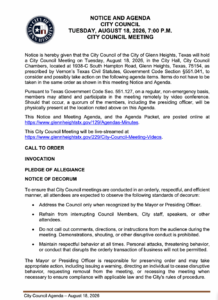
It says disruptive attendees may be warned, directed to stop, removed, or the meeting may be recessed.
There is no evidence the language was added because of the Aug. 4 exchange; Glenn Heights Future is not suggesting that it was.
However, the optics are impossible to ignore.
Residents have watched a neighbor get shut down from the dais; they have spent weeks voicing opposition to one of the city’s most consequential proposed developments. Now, they will arrive at City Hall to find an explicit reminder about when they may—and may not—speak.
Council has every right to maintain order. Residents do not have a right to commandeer meetings, shout over elected officials, or prevent public business from being conducted.
However, City Hall should be equally careful not to confuse decorum with deference.
Citizens owe their government civility. They do not owe it agreement.
The people aren’t powerless.
What happens when that disagreement becomes fundamental? Glenn Heights’ own charter provides part of the answer.
The city is governed under a home-rule charter that reserves substantial authority to citizens, including initiative, referendum and recall.
Recall is not a political reset button for voters unhappy with a decision; the charter establishes specific grounds and procedures, and nothing presented here suggests disagreement over the data center itself satisfies them.
However, the larger principle matters. The people of Glenn Heights are not spectators in their own government.
They can organize, petition, request records, contact council members, attend meetings, support candidates, become candidates and exercise charter rights where applicable. And, ultimately, vote.
Elections have consequences for elected officials, too.
Listening is part of governing.
None of this requires Brown or any council member to surrender their judgment to the loudest Facebook comment.
Leadership sometimes means making unpopular decisions. However, leadership also requires recognizing when skepticism has become opposition—and asking why.
Over the past several weeks, Glenn Heights residents have raised questions about taxes, development, water infrastructure, the data center, and how their government communicates with them.
Those questions are not going away because a graphic is published. Nor will disagreement disappear because everyone follows the rules at Tuesday night’s meeting.
Government works best when residents listen to their elected officials. The reverse is also true.
Publish the numbers. Answer the questions. Correct misinformation. Make the strongest possible case for why this development belongs in Glenn Heights. Then listen.
If residents understand the proposal and still don’t want it, City Hall eventually has to confront a question no infographic can answer: What part of “no” isn’t being heard?
Follow the full project: See GHF’s Glenn Heights Data Center timeline, Chapter 380 agreement, source documents and continuing coverage: www.glennheightsfuture.com/data-center